A sustainable Chicago


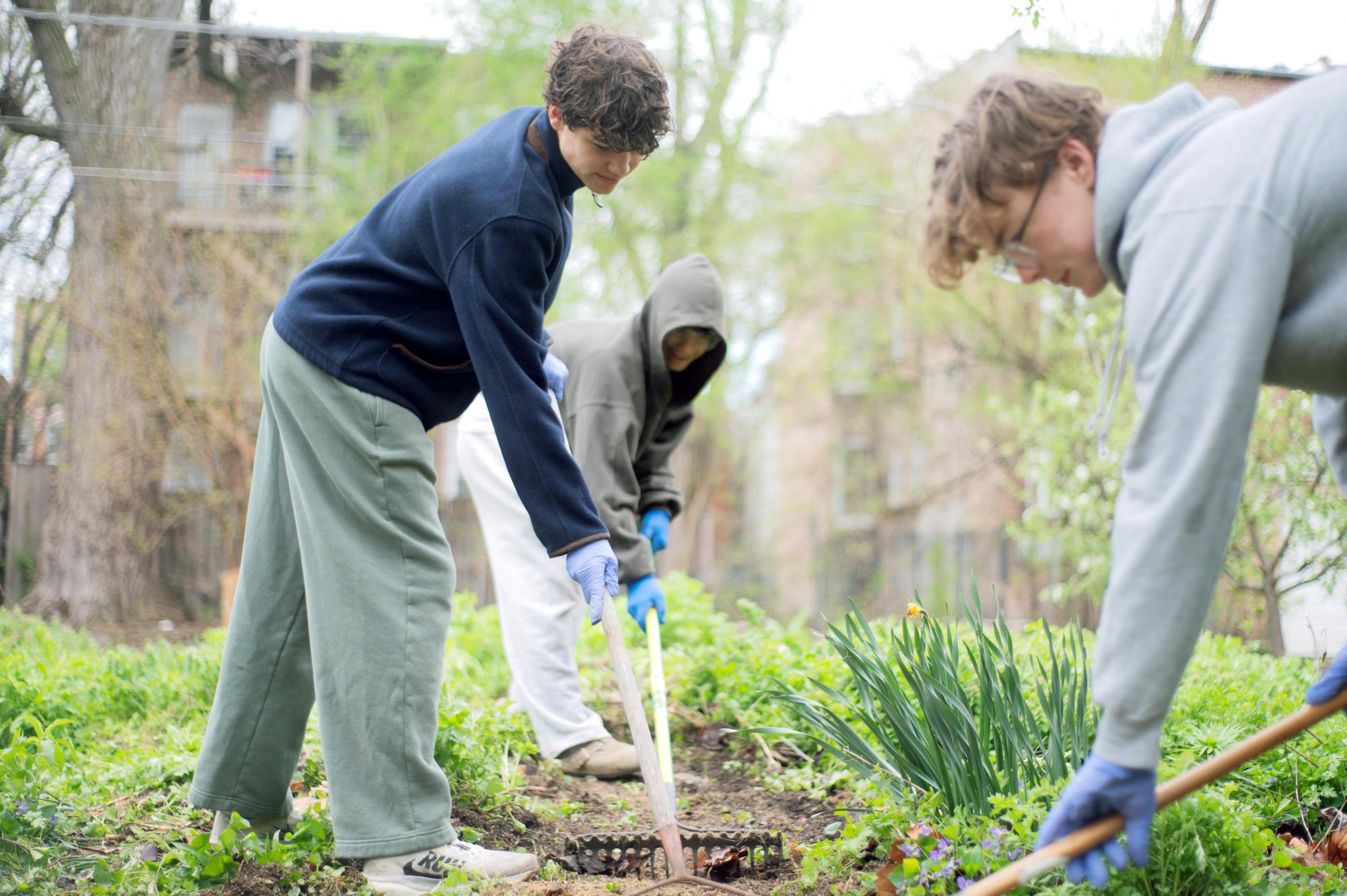
Just off East 61st Street, a vibrant garden interrupts the uniform rhythm of the surrounding buildings. Trees, flowers and bushes are arranged in a neat circle, offering a streak of color to the neighborhood, while a small group of volunteers clears fallen leaves and tends to the soil.
This space isn’t just a garden. It’s the direct result of an environmental justice initiative led by Blacks in Green, a national network that aims to reduce America’s racial wealth gap through sustainable technologies.
As part of its Sustainable Square Mile project, the organization has planted and maintained three public gardens throughout the city, in addition to planting over 400 trees in the West Woodlawn neighborhood. This is one among many initiatives, which also include renovating the childhood house of Emmett Till.
Duane Jarrett, a chief gardening officer for Blacks in Green who has helped design and implement two of their gardens, described the network as a multifaceted attempt to address generational inequities in Chicago’s communities.
“We have a focus on green living and encouraging gardening to resolve problems with heavy pollution and a lack of a tree canopy,” he said.
He noted the impact of trees, and green life in general, on health.
“We know that trees are contributors to prosperity and courage, to clearing one’s lungs,” Mr. Jarrett said. “The Amazons have been called the lungs of the world, but the tree canopy here is the lungs of the city.”
According to Mr. Jarrett, these gardens and tree-planting projects began with the intent of reducing the racial equity gap between neighborhoods of African American descent and those of European descent.
They particularly focused their efforts on neighborhoods that were neglected, polluted and underplanted.
“The goal was to correct the gap on many levels, to establish our own energy,” he said. “Blacks in Green has encouraged innovative approaches to energy, using solar, even wind and geothermal energy.”
This is part of another of Blacks in Green’s initiatives: a pilot program in West Woodlawn to create geothermal heat at home. They plan to implement a federal grant to build a shared geothermal network for the Woodlawn community, though for the moment, the possibility has been sidelined.
According to Mr. Jarrett, this temporary delay is due to the Trump administration’s position on the environment.
“They’re no friend to alternative energy,” he said.
However, Mr. Jarrett said, the organization’s efforts have generally expanded in recent months, partly due to the increase of volunteers, some from the U-High community, who help contribute to garden maintenance.
Blacks in Green’s projects are reflected in the environment already. Stepping into Woodlawn, their impact is visible throughout 61st Street and beyond, though it will continue to shape Chicago’s neighborhoods.
Mr. Jarrett said, “Overall, it’s been helping turn green land into a garden.”
At its launch in 2008, the Chicago Climate Action Plan was among the most ambitious climate commitments in the country. Richard M. Daley, Chicago’s mayor at the time, introduced the plan with the goal of reducing Chicago’s greenhouse gas emissions by 80% below the 1990 levels by the year 2050, meaning the city would only be allowed to emit about 7–8 million metric tons of greenhouse gases, or GHGs, by that year.
While that may sound gigantic, Tokyo and Shanghai each produce an average of about 250 million metric tons of GHGs each year.
Progress on this proposal has been slow, as Chicago still produces 152 million metric tons each year, according to a 2026 report from the Chicago Metropolitan Agency for Planning. With its slow advancement and the rolling back of federal climate support, Chicago’s advocates and alderpersons are pushing a slate of local policies to close that gap. Here is where things stand:
Clean and Affordable Buildings Ordinance
Buildings currently account for 68% of Chicago’s total greenhouse gas emissions. In January 2024, Mayor Brandon Johnson proposed the ordinance, which would require that any new building or major renovation — meaning additions over 10,000 square feet or 25% of an existing structure — be built without systems that burn fossil fuels and effectively ban natural gas-powered systems. While this ordinance is still being pursued by Mayor Johnson’s administration, the goal remains to reduce gas systems in new construction in favor of electric or other low-emission alternatives.
Hazel M. Johnson Cumulative Impacts Ordinance
Decades of zoning decisions have concentrated factories, scrapyards and freight facilities in predominantly Black and Latino neighborhoods in Chicago. This 2025 ordinance, named for the “Mother of Environmental Justice” Hazel Johnson, who has no familial relation to Mayor Johnson, would require any company seeking a permit for a new heavy industrial facility to first complete a study measuring how much pollution already impacts the surrounding community and how a new facility would add to it.
Environmental Lobby Week
Rather than an ordinance or act, this annual event, held from March 30 to April 2, pairs about 200 residents with their alderpersons, grouped by their wards, to discuss environmental policies that have been proposed in Chicago. This year’s discussions included creating bird-friendly building standards, reducing single-use plastics and increasing city funding for environmental programs. A second Lobby Week is planned for 2026.
Behind the politicians and well-known faces of Chicago, groups of people work for free to keep the city sustained. These are the volunteers of Chicago. From sophomores to professionals, many Chicagoans — especially students — participate in different acts of service to help the city.
At the University of Chicago, students have formed the Phoenix Sustainability Initiative to sustain their four-year home. From composting to chalking the quad, PSI members hope to engage and educate the UChicago community about sustainability and ways to make an impact.
“The thing that I think is really valuable about sustainability, that a lot of people might not necessarily see, is that anyone with any kind of background, with any kind of interest, can and should be interested in being involved in sustainability,” Annie Yang, PSI co-president, said. “I think it is, or can be, or should be, embedded in basically everything.”
PSI promotes ways to live a more sustainable lifestyle, such as sewing or mending clothes, and offers weekly workshops.
PSI members also work with legislators and other sustainability organizations, on initiatives such as environmental justice bills at the city or state level, Ms. Yang said.
For Earth Day on April 22, PSI put information about their group on the UChicago quad in chalk to spread awareness and bring to light opportunities of service for Earth Day and the surrounding week.
“We always chalk the quad for Earth Day. Whoever is free goes out at about midday and then with a bunch of chalk we draw a big earth with slogans, little animals, bio-diversity,” Ms. Yang said. “We are just reminding people that it is Earth Day, and it was just a fun social thing for us.”
At Lab, on top of the sophomore service learning project, there are many opportunities to volunteer and students who take advantage of these opportunities. Senior Grace LaBelle is the co-president of the Humanity Hyde Park club, a food-sustainability group that volunteers on Saturdays biweekly at the Hyde Park Food Pantry. Grace believes that volunteering is a source of power and a way to use your voice in your community.
“In a time where you can feel so powerless and like you don’t have a voice, going to these service places and seeing your work pay off in real time is huge and it is a big reason why I keep coming back,” Grace said.
When feeling small in the big city of Chicago, Chicagoans have turned to sustainability initiatives to uplift their community and keep the city running.
“There are so many people who want to help, and there are so many people who need your help,” Grace said. “I think that it is really important that people volunteer, especially at a time when people are so in need, and our city is in need.”