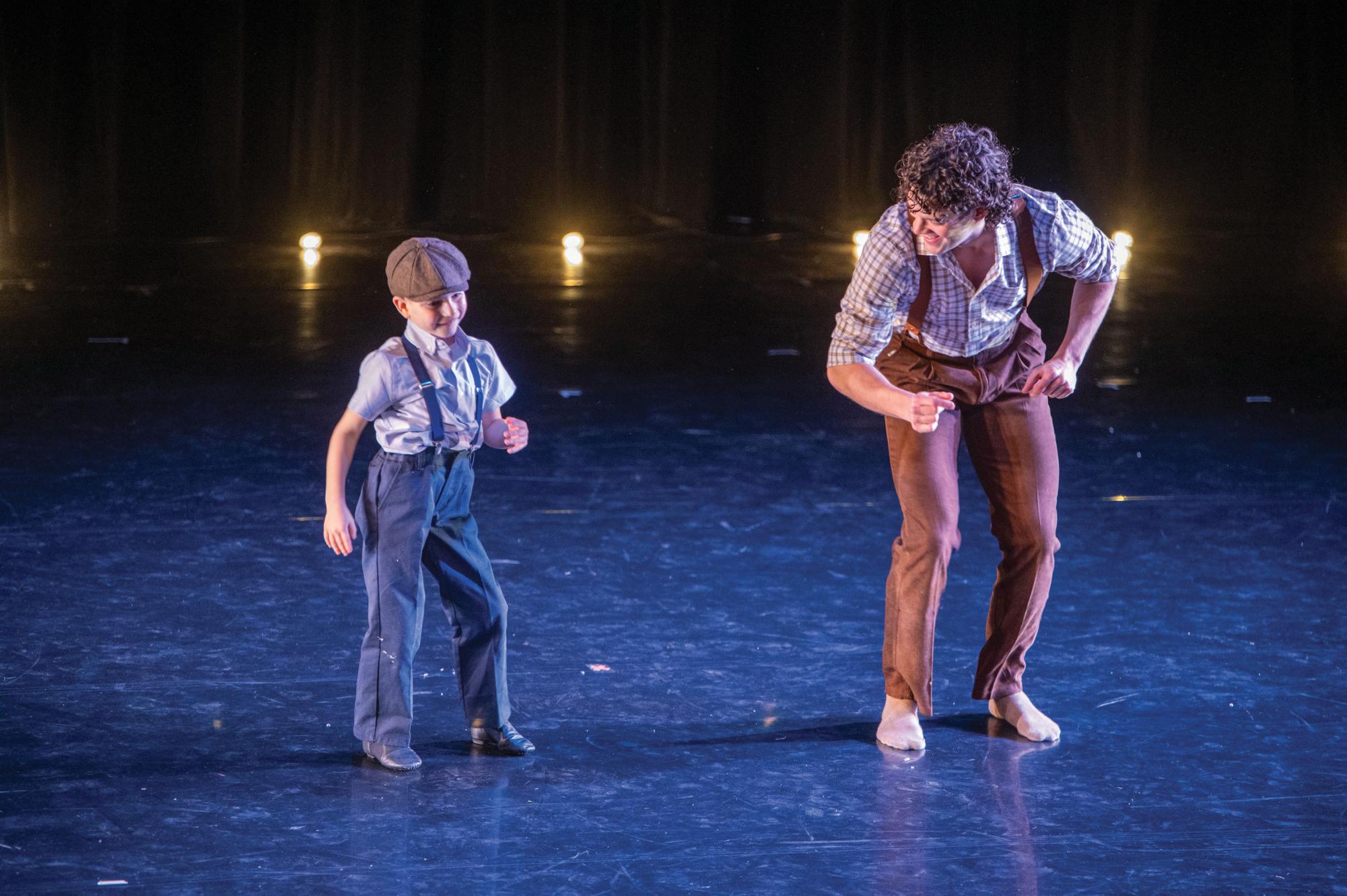

A young boy and his father dance around a Christmas tree to the strains of “O Holy Night.” It’s an idyllic holiday card scene — a moment ruptured when jarring radio static cuts through the harmonies and the choreography becomes increasingly staccato and angular. The result is unsettling and unexpected.
Though set to a traditional Christmas soundtrack, the performance is a far cry from the conventional “Nutcracker” ballet.
This is a scene from “Lamentations for Peace,” the latest work by Kia Smith, an innovative choreographer and South Side native who founded South Chicago Dance Theater in 2017 and whose work pushes the boundaries of experimental performance.
When Ms. Smith started formal dance training at 16, she quickly realized she wanted to pursue the art professionally.
“Dance is my home. It’s the one place where I can fully be myself,” she said. “Starting the company didn’t feel challenging because I’ve always wanted to do it. Being a director and choreographer is my calling, my purpose.”
She trained in various South Side neighborhoods, including Chatham, South Shore and Kenwood, dancing at community centers and her high school, King College Prep. She was then selected to study on a full scholarship at Hyde Park School of Dance. Ms. Smith’s first professional dance teaching job out of college was at Lab, where she led classes during the summer.
Experimenting with different styles and expressions of movement is an integral part of her work. She often asks her dancers to go beyond what’s expected and hone different aspects of their artistry.
“For the performance we did last spring, one of the pieces required the dancers to speak on stage,” she said. “It brought a different dimension to the performance.”
Ms. Smith’s creative process involves immersing herself in other art forms outside of dance, which usually includes a monthly trip to the Art Institute of Chicago.
“Last year, I spent a lot of time in the Modern Wing looking at the surrealists,” she said. “I was really interested in the philosophy behind surrealism and how your work can come from the subconscious mind.”
She was inspired to create a show based on surrealism and its embrace of subconscious thought. In one scene, dancers moved manically, throwing clothes. In another, they recreated a Parisian cafe.
However, in the white-dominated world of ballet, Ms. Smith hasn’t always felt comfortable.
“Now, programs are more diverse, but when I was in college, out of the 150 or so dance majors, there were only four or five Black dancers,” she said. “I didn’t really know how I fit in.”
For a time, Ms. Smith, who identifies as African American, almost quit dancing altogether. But she was emboldened by attending the annual International Association of Blacks in Dance conference.
“I saw so many companies and artists of color and thought, ‘Oh OK. So I do fit into the dance world,” she said.
Hyde Park’s vibrant, multicultural atmosphere has deeply influenced Ms. Smith, whose company now performs all over the world, from South Korea to the Netherlands and Colombia.
She said, “If I can be in a place where I am around people who don’t think like me, who don’t look like me, who have different ideas than I do, then I’m in the right place.”