



















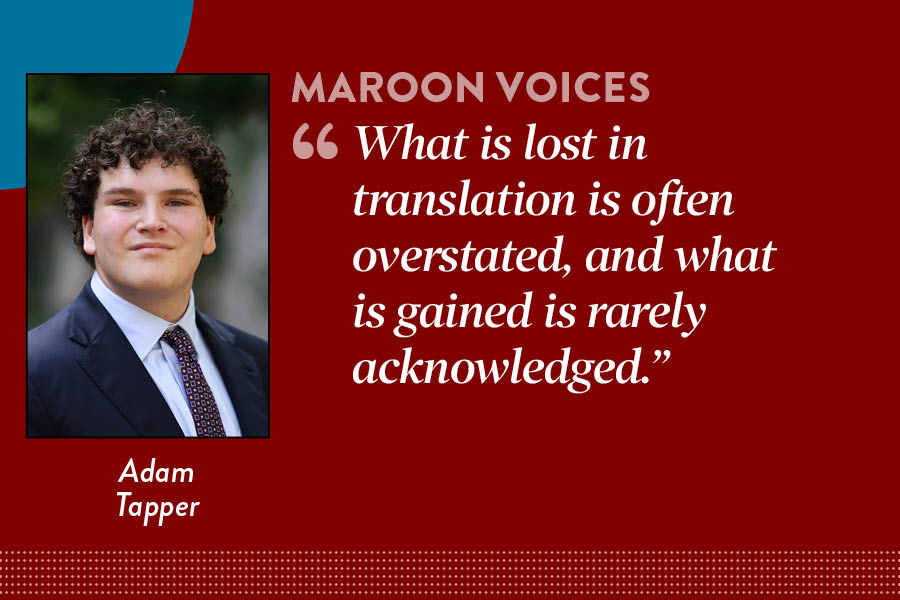
The Midway is committed to representing a wide range of perspectives and viewpoints, including from students not on the Midway staff. Our Maroon Voices series will feature guest columnists on a wide range of issues.
During the summer of 2024, after my sophomore year, I attended the Great Jewish Books Summer Program at the Yiddish Book Center, tucked into the hills of western Massachusetts. During one small-group discussion of Yehuda Amichai’s poem “The Place Where We Are Right,” my peers began questioning the English translation of the poem, originally written in Hebrew. Eventually, the conversation reached a familiar conclusion: that a translator could never truly render a poem at all.
The idea that something inherent is lost in translation is so familiar it barely gets questioned; in fact, there’s a centuries-old Italian saying, traduttore, traditore —“translator, traitor.” But treating translation as betrayal assumes a work can only exist in one form. Translation is not a supplement to literature, but a necessary condition for its expansion beyond a single language.
This skepticism manifests itself in the books that make it to our shelves. In the United States, only about 3% of published books are translations, according to a program at the University of Rochester, and the vast majority of these are from European languages. This linguistic hegemony is unique to the English language market. In Germany, around 15% of titles published annually are translations, and in China translations consistently top bestseller lists.
This scarcity shapes not just what we read, but how literature itself is allowed to move and change. Without translation, literature would remain bounded by language, and ideas or forms that now circulate globally would be confined to their original linguistic communities.
Literary movements do not become global because writers can read all 7,000-plus extant languages, but because translation allows styles, risks and innovations to travel. According to a 2023 study conducted by the Booker Prize Foundation, readers of translated fiction are more likely than fiction readers overall to seek out challenging works, to read across genres and to read for knowledge rather than entertainment alone. This is because literary translation is not defined by word-for-word equivalency; rather, it is a creative medium through which literature leaves home. Without translators, poetic forms like the pantoum would have never traveled beyond the Malay archipelago, and writers such as Gabriel García Márquez would have never encountered the work of William Faulkner. These connections have fundamentally altered what readers around the world now recognize as contemporary literature.
What is lost in translation is often overstated, and what is gained is rarely acknowledged. Translation allows us to bridge the gaps between language and thought, and asks the reader not only to interact with the foreign, but to become foreign themselves. To read in translation is to resist both erasure and the assumption that familiarity equals authority, and to accept that literature belongs to the many. It is a choice to let language unsettle us, to bring other perspectives to light, and to recognize that meaning survives through translation, not in spite of it.
