





















Voice-over: From spring through early fall, Lab’s garden hums with the buzzing of thousands of bees. In early March, however…
(NATURAL SOUND OF WIND IN THE GARDEN)
VO: The hives are empty. Bees don’t tend to survive the Illinois winter. Daniel Calleri, Lab’s head beekeeper and a biology teacher, says this is partially because of a lack of research.
DANIEL CALLERI: So, you’d think, with all the people who rear bees, that somebody would have this figured out. There’s very little literature about why they don’t. There’s just a lot of sort of what, to most folks, seem like logical statements.
VO: There are some understandings about the challenges bees face in the winter, from access to food to diseases and unhealthy hives, but there’s still no consensus about how to overwinter a population.
CALLERI: These are also not, from an evolutionary perspective, a northern climate animal, where we have raised them in northern climates.
VO: Because of the lack of bees, Dr. Calleri sources new ones from Southern states, where they spend the winter pollinating fruit trees. .
CALLERI: So, I will buy bees from a person, who sells bees, and he puts 30,000 hives into trucks and goes to California and participates in the whole pollination thing of the, mostly fruit trees in California, is how they pollinate them with the bees. And then he boxes the bees back up, and he comes here, and he uses a kid you not, a special kind of vacuum, and he sucks bees out of a hive into a box.
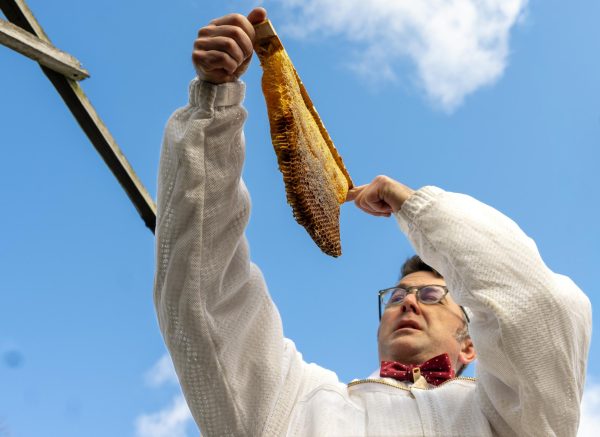
VO: During the bee-less winter months, Dr. Calleri spends his time busy as a bee preparing Lab’s apiary for spring.
(NATURAL SOUND OF BEEHIVE BEING PREPARED)
CALLERI: It’s like spring cleaning. You just sort of, you go in, you clean it out, you make sure that there’s, um… nothing growing in there. Sometimes there’ll be, you know, those sort of white, uh, egg structures that the spiders leave behind. You want to get rid of that. Make sure that there’s no ants kicking around, check the structure itself, structural integrity, like, does the wood sound good, all that stuff.
VO: An apiary is the location in a garden or property where bees are kept. Lab’s apiary has two hives in a fenced off area at the back of the garden. It was originally founded in 2014 by a U-High senior.
CALLERI: Her name was Katie, and Katie wanted to do a May project. Um, because her dad had been a beekeeper for a while, and she kind of wanted to strike out on her own as a kid and make her own.
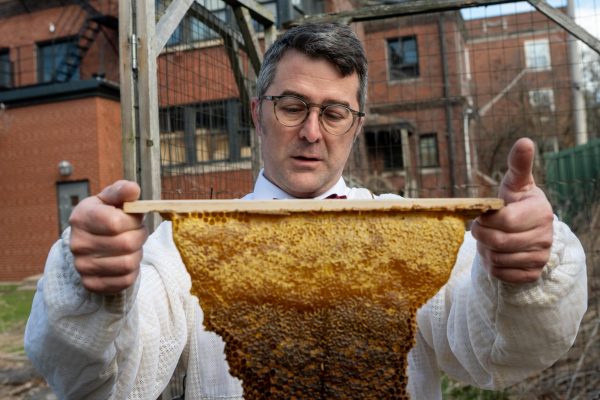
VO: Katie, Dr. Calleri, and the rest of the AT Biology class spent a majority of that spring working on the apiary, filling out paperwork, and talking to local beekeepers. But the apiary isn’t just there for fun. The bees’ honey is sold at fundraisers and made into soap and chapstick. Science classes at all levels come out to learn from the apiary. Assistant beekeeper Jeff Maharry brings his 5th Grade classes out every spring.
JEFF MAHARRY: With my own science classes, we’re talking about how pollinators are essential for flowering plants to produce new seeds and to reproduce. So we talk about, uh, that they have visited flowers, and they’re arriving back with the pollen that they use for protein and their own food.
VO: Mr. Maharry also meets with Earl Shapiro Hall classes to teach younger students to be comfortable around bees or other insects and understand them better.
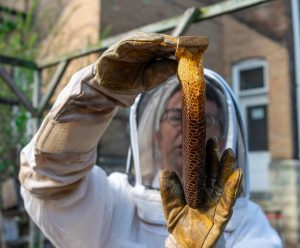
MAHARRY: I try to get them to understand that if you look closely, like honeybees are not, the most common insects that you see around. When you’re in the outdoor classroom, there’s lots more bluing wasps, or paper wasps, or yellow jackets, and the honeybees are just one of a number. So to just get them to be more calm, so that you can actually use the powers of observation that human brains are capable of.
VO: As spring rolls around, preparations for this year’s bees are in full swing, both in and outside the classroom. Reporting for the U-High Midway, I’m Reed Francez

