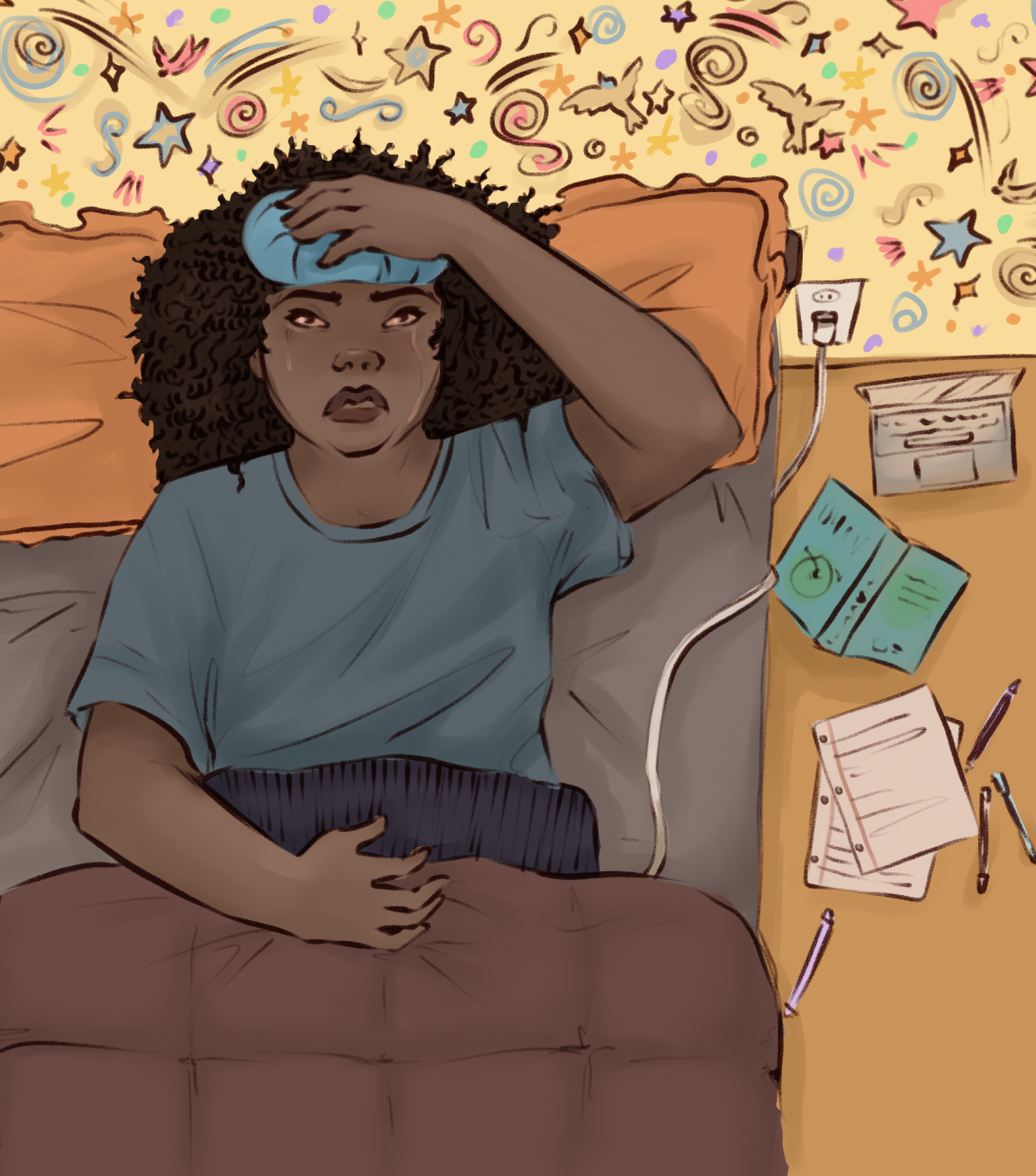





















From the onset of symptoms — fever, nausea and a distinct, sudden and intense pain in the scrotum — a young boy only has six hours before surgery is no longer an option. It’s a condition many people don’t know about or take seriously. In fact, many people are afraid to discuss it, even with family members.
“I was sitting there for like 15 minutes,” said Student A, a male U-High student, recalling his experience when he was a ninth grader, “and then after a second, I just decided, you know this is kind of embarrassing. I don’t want to tell my parents: ‘Can we go to the hospital? My balls hurt.’”
What Student A experienced was testicular torsion, the twisting of the spermatic cord, which cuts off blood supply to the scrotum — the skin sack that contains both testicles. It’s most prevalent in boys and young men during puberty, and without proper treatment or untwisting within a period of 4-8 hours, the affected testicle could die.
Dr. Piyush Agarwal, a urologic surgeon and professor of surgery at the University of Chicago, stressed that testicular torsion requires immediate attention.
“We go straight to the operating room,” Dr. Agarwal said, after torsion is ruled as the reason for testicular pain. “It’s considered a surgical emergency.”
Torsion’s symptoms involved immediate, rapid and often debilitating pain in the scrotum, abdominal pain, fever, burning, nausea and vomiting according to the Mayo Clinic. Aside from age, the condition has no other risk factors and can develop randomly.
For Student B, another U-High student, the torsion occurred randomly and shockingly during his junior year.
“I woke up, I remember… about half an hour before my alarm went off,” Student B said, “and from that point on, it just got progressively worse.”
This is a common occurrence of torsion: it often wakes affected individuals up from sleep, according to the Mayo Clinic.
Even though one can live a relatively normal life with only one testicle, Dr. Agarwal underscored the urgency of the condition and the need for teenage boys to be aware of its risks.
“It’s something that [is] well known that can happen in boys, and there will be a lot of regret later if you go in too late, and then, have to have that testicle removed, even though you can live a completely normal life,” Dr. Agarwal said. “It’s just something that can be avoided.”
Both Student A and Student B were diagnosed with intermittent testicular torsion, which means that their spermatic cords were twisted and naturally untwisted. Often, though, with intermittent torsion, the testicles will retwist. For this reason, it is also encouraged to have an orchiopexy, a surgery to stop the twist and recurrences, Dr. Agarwal said.
Student A hopes people can forsake their embarrassment and prioritize their health.
“I think more people should know that if it happens to them, they make the right choice to be a little bit embarrassed and save their balls,” Student A said.
Both Students A and B have experienced jokes after they’ve told people they have had torsion. While neither took particular offense to the jokes, Student A found them annoying.
“And people still joke like, oh, [Student A], what are you talking about? You don’t have balls anymore,” Student A said. “They’re dragging it, OK?”
Student A thinks that being a high school student makes torsion a particularly difficult medical condition to approach.
“I think in high school, people are very concerned with how people see them,” Student A said. “But that’s still not as important as your well-being.”