


















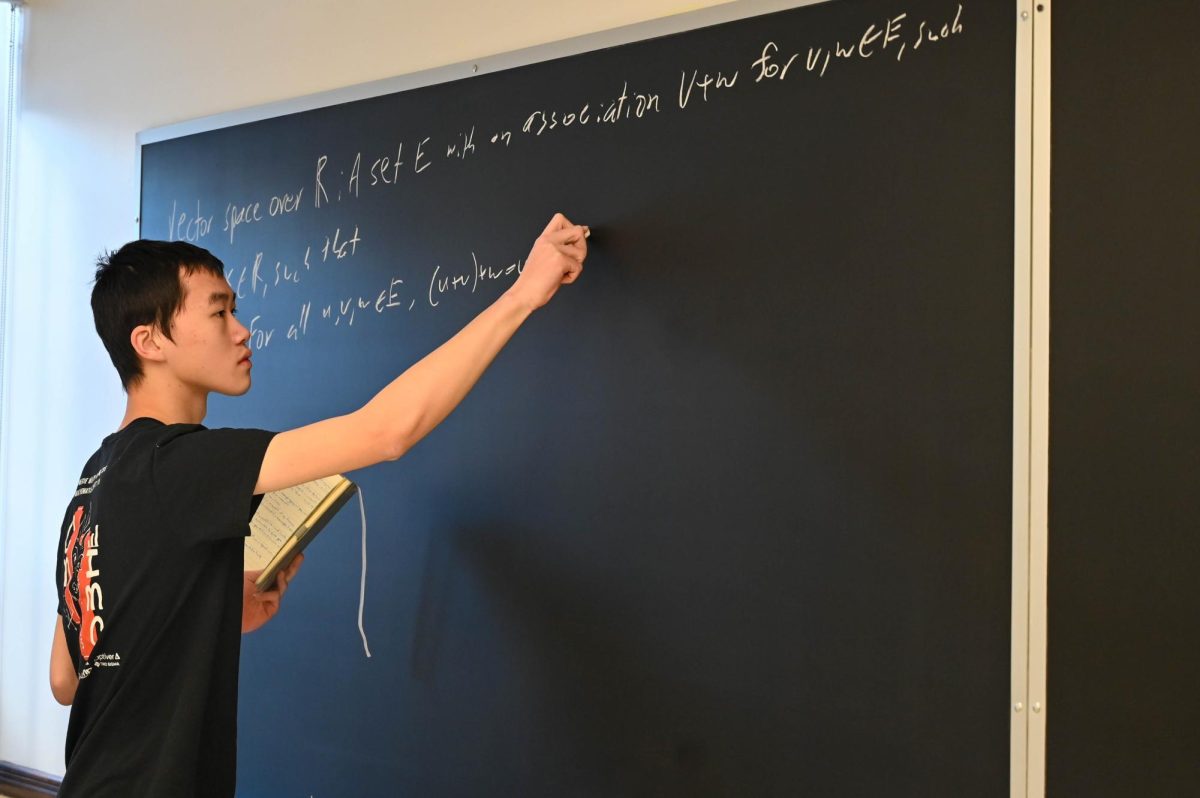
To most, topology is the complex study of invariants, the properties of shapes that are preserved even when the shape is altered. To Senior Victor Chen, it’s his focus of study and just one piece of his proof that math can provide many means to understanding the world.
Whether by solving an elegant proof, developing a biological algorithm or taking on a grid puzzle, math has been an invariant part of Victor’s life for seven years, and it shows no signs of ending.
Victor’s success in math has taken many forms. He’s the captain for the Science Olympiad and math teams. He has won the USA Junior Mathematical Olympiad’s honors and gold medals in Science Olympiad. He entered the competitive math scene in fifth grade at the Latin Math competition to experience challenging math outside the classroom. Now, he’s doing more proof-based math, such as in the USA Junior Mathematical Olympiad.
“I’m finding that I really enjoy how you get to sort of construct and discover these truths by yourself that are often really beautiful,” Victor said.
To explore even further in proof-based math, Victor has taken up an independent study on topology with math teacher Farukh Khan.
“I saw a video on topology that was proving that in any curve, you could find four points that form a rectangle,” Victor said. “I won’t go over the details of the proof here, but it’s like a really, really, elegant proof,” Victor said. “I just wanted to explore more on that.”
Aside from the thrill of a challenge and the satisfaction of solving an elegant proof, Victor also finds the puzzle-solving aspects of math engaging. As a puzzle fan for the past few years, he founded Grid Puzzles Club to help share that feeling with others.
“I just think they’re really fun to do,” he said, “and they train you to be patient and persistent, because they’re like, these huge puzzles — like 31 by 45, a huge grid.”
According to Victor, being a leader and member of teams and clubs has given him the opportunity to find community in the field he loves.
“I mean the community, of course, is like something I really enjoy too … Finding other people who can sort of enjoy that thing in the same way,” he said.
But when it comes to using math to understand the world, one of the most direct paths is the sciences. In the past two years, Victor has also participated in the MIT PRIMES-USA program and the Clark scholar Research program to learn more about how to use math models to solve biological problems.
“Something that was really cool to me is when you’re modeling probabilities and evolution … you can actually use it to sort of model, like the probabilities of specific mutations in biology,” Victor said. “That’s just something I found really cool, because you have this sort of abstract piece of mathematics, but it’s used in a very real sense.”
Victor plans for math to continue to be a central part of his focus, and in his eyes the next stretch that the invariant will be put through will be going beyond functions and discovering the world around them.
“Math, to me, is about discovery,” Victor said. “But it’s discovery both in of itself as a pure subject, and of how it describes the real world. I really want to pursue applied mathematics in college, and part of my motivation for liking science and math in the first place is that I just want to find out more about how the world works.”
