




















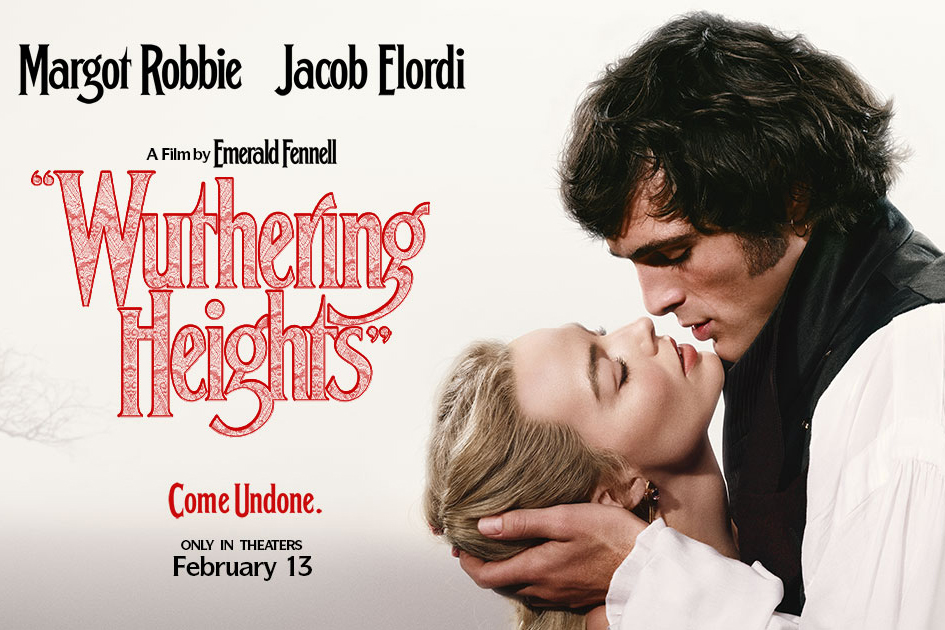
It is decidedly intentional that “Wuthering Heights,” the title of Emerald Fennel’s new book-to-movie adaptation, is cushioned by quotation marks.
Ms. Fennel seems well aware that the movie does not faithfully follow Emily Brontë’s source material. One could name many obvious differences; perhaps that the movie omits a full generation of Brontë’s second-act characters. Perhaps that Cathy and Heathcliff (a petulant Margot Robbie and a boorish Jacob Elordi) engage in an indulgently torrid affair onscreen that never occurs in the book. Or perhaps that Heathcliff, pointedly described in the novel as “dark-skinned,” is played by a pale Australian heartthrob. For a Brontë purist, any of these may be reasons to write off the movie entirely.
But, putting aside for a moment the differences in plot that Ms. Fennel clearly implemented with intention, the film’s fatal flaw is a different kind of diversion from the book: a total lack of regard for the character’s various complexities and moral inadequacies. Cathy and Heathcliff are treated as blunt instruments, symbols of a doomed romance, and the two are never blamed for the inevitable failure of their relationship.
In fact, Ms. Fennel changes the story’s villain entirely. She doesn’t want you to blame Cathy, though it was her carelessness and pride that cause Heathcliff to flee for the five years they spend apart. Ms. Robbie — crumpled to the floor in a stunning gown, acting her heart out — sobs “It would degrade me to marry him,” not realizing he is within earshot just outside her bedroom door. Nor are you to blame Heathcliff, brutish though he is — Mr. Elordi does act the character impressively, transforming from a shaggy, protective stable boy for the movie’s first half to a sex-crazed, domineering aristocrat for the second while maintaining nuance and heart. You are to blame Nelly, Cathy’s lady-in-waiting, who routinely burns correspondence from Heathcliff before it reaches Cathy. She is the monster that keeps the lovebirds apart.
To divert the audience’s attention to a caricatured “bad guy” while Ms. Fennel knocks the faces of her Heathcliff and Cathy dolls together is to fundamentally misunderstand the conceit of Brontë’s story. In the novel, it is not the fault of Nelly, nor is it even the fault of Isabella (Cathy’s daughter-in-law who eventually marries Heathcliff), that Cathy and Heathcliff cannot be together. Unfortunately, it is no one’s fault but their own.
“Degrade me to marry him,” indeed — it is Cathy, from the very start, who decides the two cannot have a future together. She is spoiled and conceited, brash with her words and almost clownishly desirous of praise. A reader of “Wuthering Heights” must reckon with the fact that Cathy is fundamentally not a good person. What does that mean for love? Can she love Heathcliff, truly, if she seems to love no one but herself? And how on earth is Heathcliff meant to love her?
But by making Cathy’s cruelties and contradictions seem insignificant in comparison to the abuse she suffers, as well as making her inherently pitiful in a teary, heartsick state, Ms. Fennel absolves Cathy of both guilt and agency, which are absolutely necessary to the nuance of her character. Her agony, it seems, erases her responsibility — not only for having inflicted this pain on herself, but for having destroyed Heathcliff in the process.
The Cathy and Heathcliff of Brontë’s narrative are both masochistic and sadistic, wicked people who end up swallowing each other whole in their confused struggle for love and revenge. Those of Ms. Fennel’s film are victims of circumstance, martyrs to passion, beautiful people undone by forces external to themselves. The quotation marks enveloping “Wuthering Heights” feel, then, more like a sheepish confession than a playful wink; this is not Brontë’s feverish nightmare of ego and appetite. It is rather a story that borrows her name, her moors and her prestige, but none of her bite.

Molly Herron • Feb 24, 2026 at 12:01 pm
This is a spectacular review and absolutely spot on! Well done