





















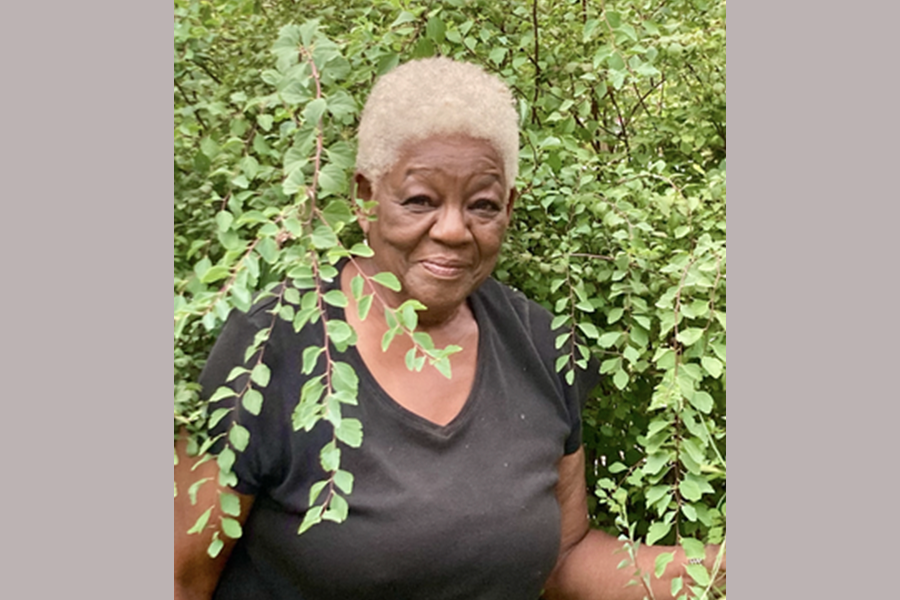
Vera Beard slices a big block of ice cream into wedges, then takes one piece and presses it between two graham crackers. She places the makeshift ice cream sandwich in a child’s outstretched hands with a smile. Even decades later, these neighborhood children, now adults, know Mrs. Beard for her kindness and always open door.
“If you had to get it from the Good Humor man, they wouldn’t have the money to get it,” Mrs. Beard recounts. “So, I would buy these big blocks of ice cream from Walgreens, and you could slice them and with graham crackers, you would have ice cream sandwiches. I wouldn’t turn any kid away.”
For more than 50 years, Mrs. Beard has been a constant presence in Hyde Park, opening her door and porch to generations of neighborhood children. Today, Mrs. Beard remains an active member of her community, known and beloved by many.
Mrs. Beard’s parents and grandparents came from Mississippi in the 1940s, shortly after the end of WWII, seeking to escape the racial segregation entrenched in the South. Her mother initially moved to Missouri before joining her husband and children in Chicago.
“My mother came to St. Louis because she was tired of the system in the South. It was basically a sharecropper slavery type thing. You just worked, and nobody owned anything,” Mrs. Beard said. “There would be two types of sharecroppers. Some may have used their own tools and stuff, they might have a mule. But there were those of us like my family who had nothing, who had no land with no tools, barely any clothes for our backs.”
The North had many inequalities as well, as Mrs. Beard’s family found. She recounted that as a child living in Chicago’s “Black Belt,” she wasn’t very aware of the other parts of the city outside of her South Side neighborhood. Only when she went on a school trip in elementary school to the Brookfield Zoo did she first get the chance to see a different part of the city.
“I remember looking through my textbooks, Dick and Jane, picture books with little beginning reading. It’s like, wow, everything is so clean. Grass, white picket fence, the kids all scrubbed up and clean. When they go out to play, they got a little kitten and a little dog,” Mrs. Beard said. “When I got in that school bus, we were all sitting singing ‘100 Bottles of Beer,’ and the more further we went out, like, everything started turning green. And I’m thinking, picture book, this, where am I? The kids, they would leave their tricycles right out in the street, and the little kids all blond and scrubbed up and I thought, ‘This is real.’”
Mrs. Beard also grew up hearing stories from the women from her neighborhood employed as domestic workers in the North Shore, similarly as they had been in the South. Listening to these conversations exposed her to the dichotomy between her neighborhood and the rest of the city.
“They would have Thursdays and Sundays off. They would come back home, come back talking about what it was like, you know, you know what — ‘Ms. so-and-so, she’s real nice. She treats me nice like that.’ And then the others would say, ‘Well this woman I work for, she’s mean as hell. She wants me to wash her nasty underwear.’” Mrs. Beard said.
After high school, Mrs. Beard worked as a clerk at a legal aid bureau, where she met her husband, an attorney. After getting married, they moved to Hyde Park, since it was one of the only neighborhoods in Chicago at the time that was accepting of mixed-race couples.
As child care was very expensive, after having children, Mrs. Beard decided to leave her job and stay home to look after them. During that time, she worked as a babysitter for the children living on her street, most commonly the children of married University of Chicago students. When it rained, she would let the children into her large basement to play on their bikes, and in the afternoons, they would sit on her porch coming back from school.
Even today, Mrs. Beard remains active in the neighborhood, loved by neighbors and the families of the children she took care of. Mrs. Beard tries to spend as much time as she can outside: going for walks, shoveling snow on the street, and at the grocery store, as she says this is her opportunity to get to know the people in the neighborhood.
Mrs. Beard’s attitude also has a strong effect on those around her. Mrs. Beard’s neighbor, Julie Oppenheimer, said Mrs. Beard’s positive outlook leads her to see the good in difficult situations.
“She doesn’t complain,” Ms. Oppenheimer said. “Her attitude is always, ‘I woke up this morning. I woke up on the right side of the dirt, didn’t I?’ I remember her saying that many times to me, and ‘Nothing came to stay always, baby’ … She’s helping me be grounded and have perspective about things.”
In a neighborhood that has undergone decades of change, Mrs. Beard remains a constant, welcoming presence. Through simple, everyday acts, she has built deep connections with the people in her community, based on care, optimism and an open door.
