



















Update, May 8: This story has been updated to include the perspective of a college counselor.
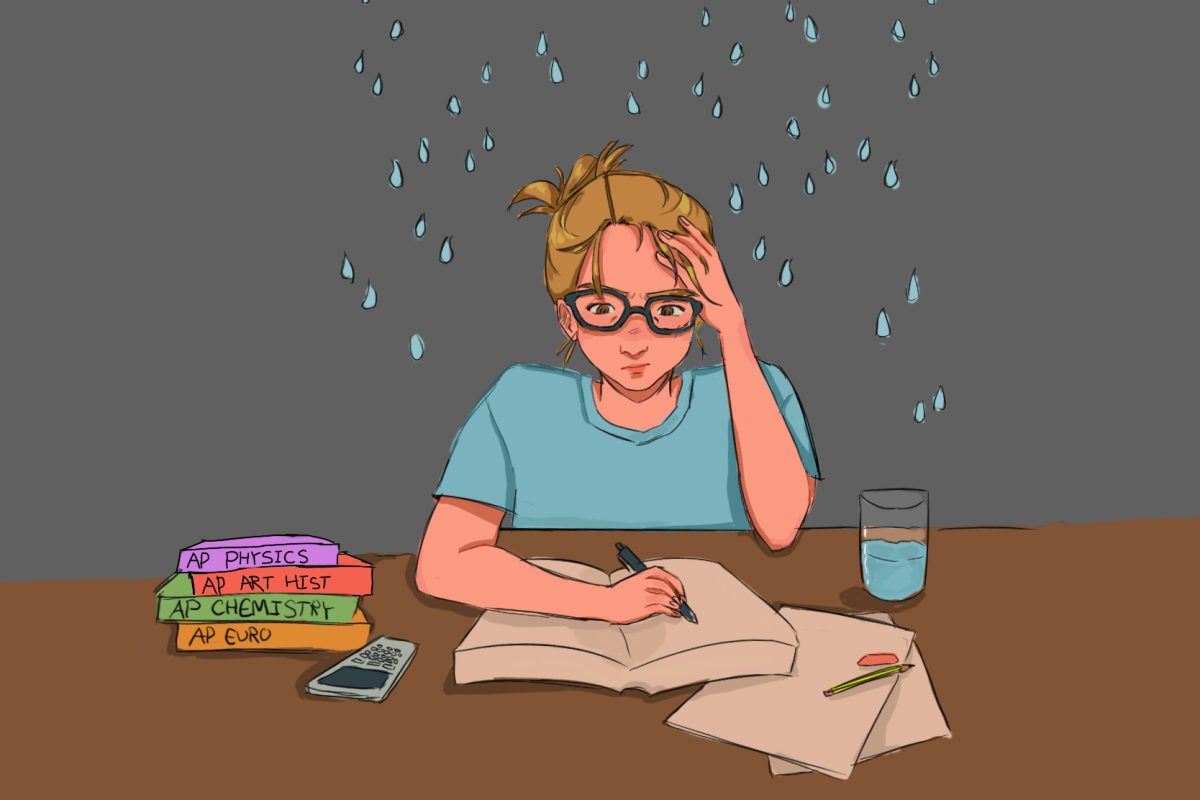
Advanced Placement exam season is quickly approaching in May, so many students have chosen to take on substantial independent work to study for AP exams, despite not being enrolled in classes specifically designed to prepare them for those exams. Many are motivated by the perception that stronger scores will demonstrate academic rigor or deepen their understanding of a topic.
Because U-High’s Advanced Topics classes are not structured around AP exams, many students feel they must go beyond their coursework to adequately prepare. While college counselors say AP exam scores don’t provide extra benefits in the college process because Lab’s curriculum is known for its rigor, many still choose to self study with hopes of earning strong scores.
College counselor Stephan Golas has found that AP exam scores hold little weight for Lab students in college admissions because Lab does not follow AP curriculum often and has a strong academic reputation. But, AP scores can help gain college credit at some schools.
“Each year, when we speak with admissions deans and directors, they overwhelmingly tell us the same thing: AP scores are not an important factor in the admissions process when coming from a school like Lab that does not teach the AP Curriculum in most disciplines,” Mr. Golas wrote in an email to the Midway. “Schools would require AP exams if they wanted them, and they do like to see them if a student has completed an AP course. But again, we have been told time and again that they do not expect these in areas where the AP Curriculum is taught. Furthermore, no college has ever told us, ‘More testing helps distinguish students at Lab.’”
Gio Nicolai, a junior who is taking four AP exams, decided to take the exams because he is interested in studying STEM in college and self-studying does not add too much to his workload. Gio is enrolled in the AT equivalent course for each exam he is taking, except AP Physics 2. He has used resources from College Board, like test questions from past years and YouTube review videos, to study and independently learn the content not yet covered in his AT courses.
“I think that since there is a lot of content overlap, self-studying doesn’t add too much to my course load,” Gio said. “I think the AP curriculum has a lot of good basic materials, and if there is not, there is always Organic Chemistry Tutor or stuff like that that can help clear up some concepts for me.”
Junior Lucia Dumitrescu is also using College Board materials to self-study for her four AP exams. Despite the added nightly work, she said the studying is manageable. The most difficult part of self-studying for Lucia has been learning important material for the exam that has not been covered in class yet, specifically in her AT Biology class.
“The AT class is very much real-world application focused, whereas the AP is more just the basic general information,” Lucia said. “We haven’t learned mitosis and miosis yet, which is a little bit frustrating because that is a really big thing on the AP. But, other than that, it’s a really good class because it does prepare you a lot for all the other units. There are just some units that you need to self-study, which can be hard.”
While AP courses teach students the content while preparing them for the AP exam, U-High’s AT courses aren’t focused only on a test at the end of the course. Chemistry teacher Zachary Hund values how AT classes give teachers flexibility to explore topics deeply and in a real-world context without having to adhere to a strict exam timeline.
“There is more to being a chemist and learning chemistry than preparing for a single exam,” Dr. Hund said. “There’s a lot of value to covering the topics that an AP curriculum covers, so it’s nothing to say that’s wrong, but I don’t want students feeling like the end-all, be-all is a single test.”
