

















Driving down South Stony Island Avenue, one can’t help but notice the soaring tower of the Obama Presidential Center. Located in what used to be Jackson Park, the museum rises from the land, but its blocky, grey design has drawn a lot of criticism.
American Sociologist Ray Oldenburg coined the term “third place” in 1989, arguing that a healthy community requires places where neighbors can connect without a price tag. Critics often point to the Obama Foundation’s $10, 99-year lease in Jackson Park as a giveaway of public land. However, viewing the center as a real estate transaction or commenting excessively on the looks of the center, we ignore the essential infrastructure and resources the center will provide for the South Side community after it opens June 19.
Unlike traditional public libraries, the 19-acre OPC campus is designed to be open to the public, with the only ticketed space being the museum itself, resulting in spaces where people of all ages can gather despite economic status.
According to the Obama Foundation’s website, the OPC’s grounds will include a new branch of the Chicago Public Library, an NBA-sized basketball court and public parkland. Additionally, the OPC will offer community outreach, teen programs and summer garden gatherings with hands-on activities.
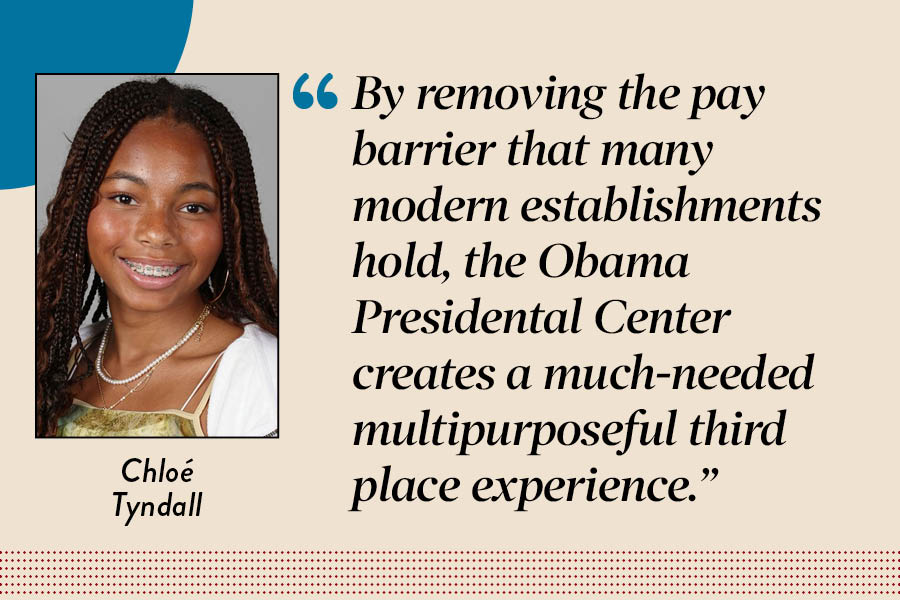
These initiatives are important because they will give people, including students, places just a few blocks from the University of Chicago to gather and study, and a place for athletes to practice. The parkland will give Chicagoans and South Siders, specifically, a place to gather with family and friends to experience nature, which is beneficial to mental and physical health. The summer garden gatherings guarantee a hotspot for the community with gardening and culinary advice. Most importantly, all of these places are free. By removing the pay barrier that many modern establishments hold, the OPC creates a much-needed multipurposeful third place experience.
In an increasingly expensive and digital world, places like the OPC are the infrastructure communities need for true neighborship. It may be easy to look at the unfinished center now and see it as unnecessary or even as an eyesore, but when driving down South Stony Island Avenue this summer, it won’t just be the “Obamalisk.” It will be space for gardening classes, studying, playing sports and most importantly, the third space that the South Side needs.
