


















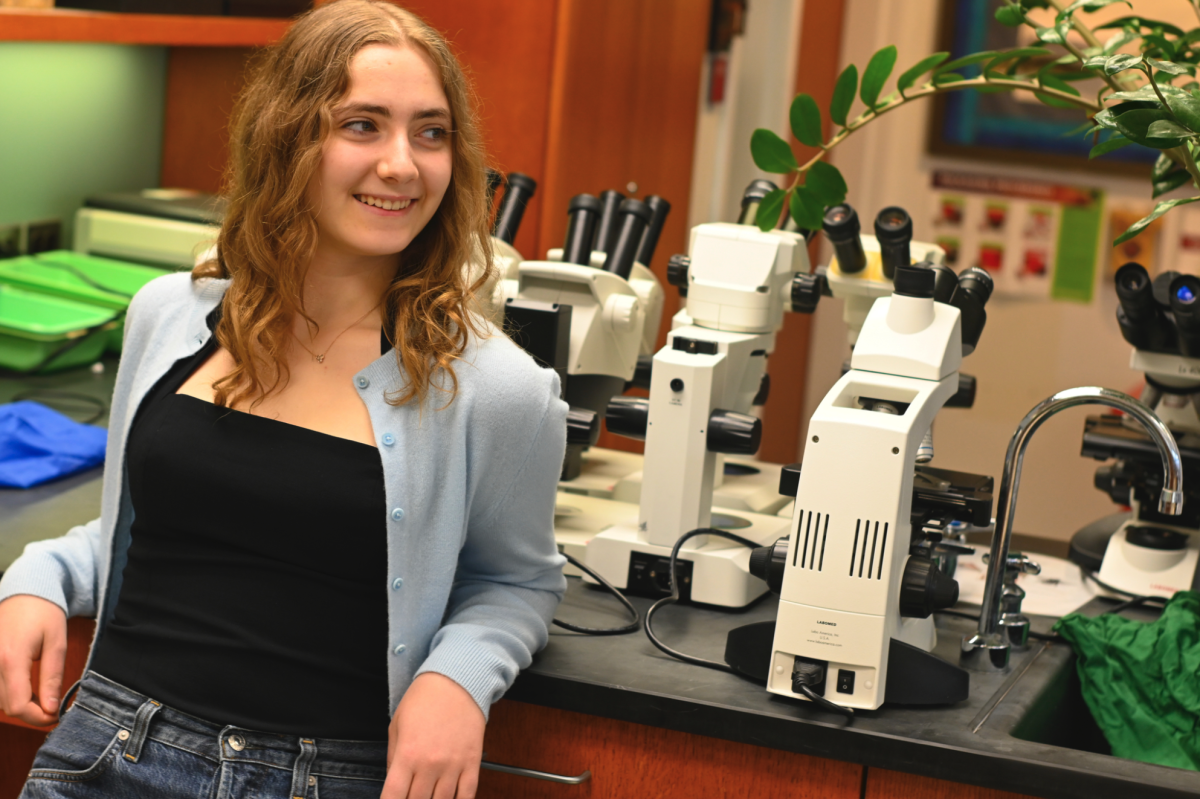
At the end of the last school year, Tal Neiman, a ninth grader at the time, decided she wanted to do scientific research over the summer. While older students scrambled for SummerLink slots or polished their expansive resumes, Tal found herself with her Biology class project being her only point of reference for actually doing research. Instead of backing away, she turned to what she always carried with her: her lived experience.
“I didn’t have any, like, research or lab experience, like in the real world, per se,” Tal said, “so I was thinking about where I have life experience that I could apply somewhere.”
In the past school year, Tal, now a sophomore, has indeed worked with university researchers. She has also published her work in a scientific journal, presented at a national conference and received a travel scholarship for her findings. Her affinity for allergy work stems not only from her general interest in science but also from her experiences with childhood allergies — and from noticing how they hindered her quality of life.
Tal had an anaphylaxis-inducing tree nut allergy that caused her to develop a phobia of needles and obsessive-compulsive disorder until she could get her allergies cared for in a special treatment program.
“My parents also started to notice me not reading allergy ingredient labels once, but reading them, like, 15 times over before eating a snack,” Tal said.
Knowing her lived experience gave her an edge, Tal reached out to Christina Ciaccio about research opportunities. Dr. Ciaccio, a professor of medicine at the University of Chicago who provides care for children and adults with allergies, brought Tal into her lab. Tal then began working with Elizabeth Carr, a postdoctoral scholar at the University of Chicago.
Under Dr. Carr’s mentorship, Tal began to work on a retrospective cohort study that looked to see if two different food allergy diagnostic tests — skin prick testing and specific in-vitro immunoglobulin E — agreed with each other when tested on patients. Agreeing essentially means that the tests produced the same results, whether the patient is allergic or not allergic.
When discussing their findings, Tal said, “We noticed that the agreements, the kappa values between the tests, increased linearly with median age. So, that was a thing that we found really interesting, and we’re gonna do more looking into that this summer.”
To actually get the results, Tal had to learn how to use RStudio, an open-source coding application, to analyze data. She appreciated that even though everyone else in the lab was older than her and credentialed, they deemed her capable, especially Dr. Carr.
“I’m lucky enough to be a part of a community that didn’t doubt my passion and didn’t doubt my ability to learn in that sense,” Tal said. “And I think that once you find one of those communities, it’s really special.”
Her dedication has certainly taken her far. After her research abstract was accepted, Tal did a poster presentation at the American Academy of Allergy Asthma & Immunology annual meeting in Philadelphia Feb. 27 through March 2. She said being there as a young person was overwhelming, but she was able to reflect on how her younger self would have felt.
“I think younger me would be very proud of what I’m doing, not only because younger me also really wanted to be a scientist and a researcher,” Tal said, “but because I think I would have appreciated knowing that this stuff is happening, knowing that people, a whole conference and more of people, really care about this issue.”
Dr. Carr said a lot of the science skills needed to work in a lab can actually be taught. What is harder to find in interns is unbridled curiosity.
“I think what you really just need for research and science is just a curiosity and also to be able to listen, follow instructions, and to end up asking if you’re not sure,” Dr. Carr said, “which Tal did amazingly.”
Tal’s background with allergies gave her a perspective that Dr. Carr sees as a great asset.
“I think a scientist, particularly in the medical field, we could never have enough empathy and sensitivity for the work,” Dr. Carr said.
While Tal hopes to one day become an engineer, she plans to incorporate her knowledge of both data analysis and public health in her career. This summer, she hopes to keep exploring these passions with Dr. Carr.
“I know that my research is gonna hopefully play a role, even if it’s a small one, it’s going to play a role into getting people more reliable, I guess, diagnostic testing, and I mean, that’s the goal,” Tal said. “The goal is for patients, and the goal is for helping people make their lives easier and increase quality of life.”
