






















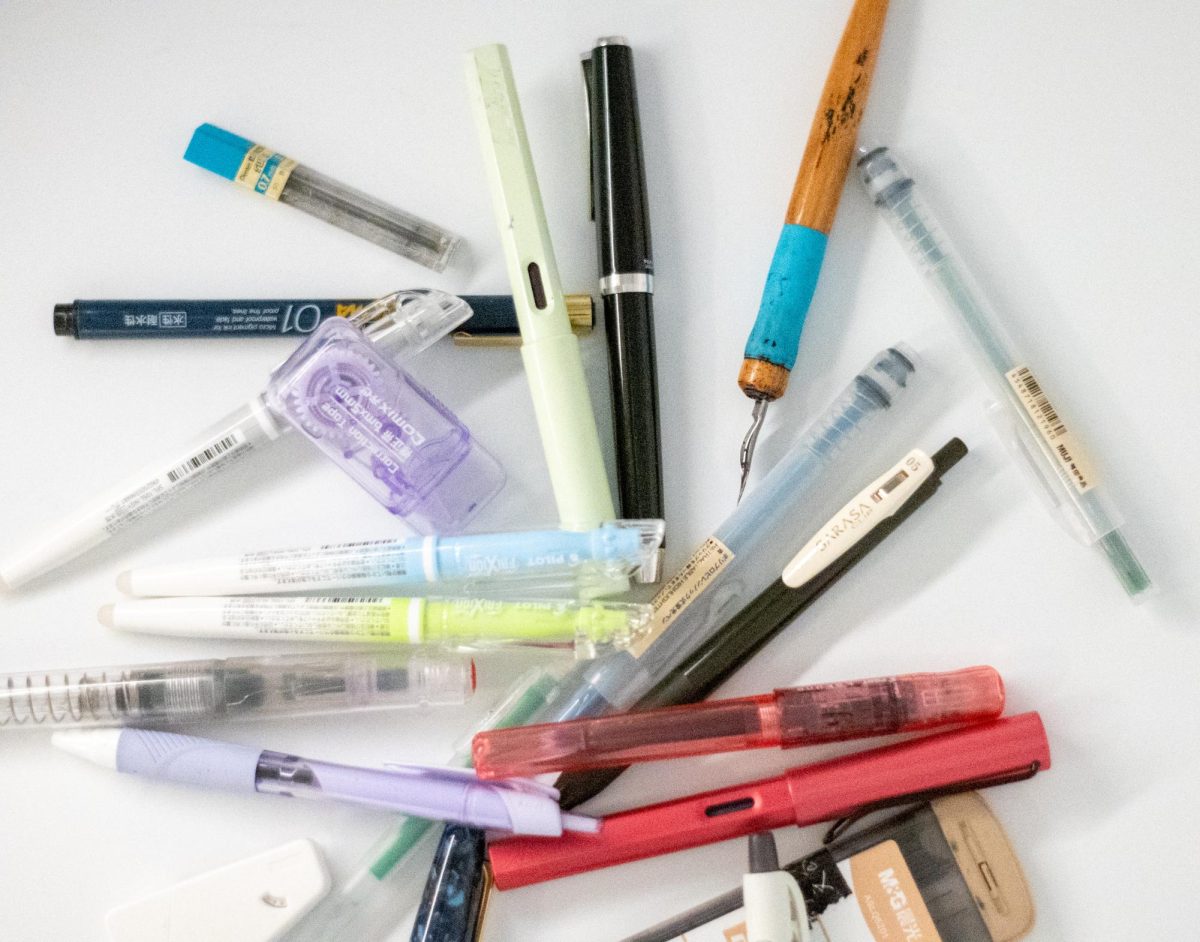
A multi-layered pencil case. Fountain pens filled with smooth black ink. Colorful mechanical pencils. Muji pens. Sarasa highlighters. Nib holders. Drawing pencils. Mechanical erasers. This is the pencil case of ninth grader Claire Dong.
Claire, a stationery collector since lower school, buys, finds and collects pens and pencils ritualistically. For Claire, pens and pencils aren’t just temporary tools to get through high school; they hold meaning and create a more enjoyable writing experience.
For many people, using and collecting high-quality tools and stationery takes away from the monotonous routine of school and brings an aspect of beauty and quality to life.
“I started liking fountain pens in fifth grade, when I saw a teacher using one,” Claire said. “Since then I’ve gone down many rabbit holes on fountain pen brands, inks, things like that.”
Claire isn’t alone. Daniel Bobo-Jones, a biology teacher, has been collecting pens and paper since the start of his teaching career over 25 years ago.
“I realized I write differently vertically on a board than I do horizontally on a table,” Mr. Bobo-Jones said. “I noticed that my handwriting was neater vertically. So I started to play around with different pen types.”
Eventually, Mr. Bobo-Jones landed on his solution: the fountain pen. Fountain pens, which come in a variety of shapes, colors, sizes, qualities, styles and even filling mechanisms, became his obsession.
“Once I found fountain pens, that was really like a spark,” Mr. Bobo-Jones said. “The collector person in me was like, ‘This is going to be bad’.”
Mr. Bobo-Jones doesn’t limit himself to pens; he’s also an avid paper collector, specifically of brands like Kokuyo and Maruman, both Japanese, which make high-quality, everyday writing paper.
“Even their student quality paper is notches above American paper,” Mr. Bobo-Jones said.
A common thread for stationary collectors is the care and attention with which the products are produced. Higher-quality stationery brands often use specific methods and materials to make their products, such as 24-karat gold pen nibs or paper made with recycled wood pulp, unlike regular printer paper.
“Writing is definitely more enjoyable with higher-quality stationery, since it’s built with ergonomics in mind,” Claire said. “It’s not just mass-produced.”
But Claire knows not everyone needs or wants the fancy stationery. Stationery, especially fountain pens, is usually expensive and can be hard to get. Buying high-quality stationery is an investment.
“The higher quality stuff only matters if you care about your stationery and you’re willing to pay the extra money and really invest in the things you buy,” Claire said. “There’s no shame in a No. 2 pencil.”
Cultures around the world have ancient traditions of calligraphy. These traditions have, over time and through globalization, evolved into modern fine writing. Handwriting went from something reserved for elites or religious groups to a part of everyday life. Fountain pens, the favorite tool of most devoted writers like Claire or Mr. Bobo-Jones, were invented as more practical versions of the traditional quill pens.
Today, Claire and Mr. Bobo-Jones’ fountain pens with their smooth, black ink not only serve as collectible, practical and fun tools but also carry a multi-millennial legacy of writing and invention that spans human history.

Daniel Bobo-Jones • Dec 18, 2025 at 4:02 pm
Brilliant!