





















Classroom pets are a staple of grade school but they are also well-loved at U-High. From lizards to guinea pigs, they’ve been shown to help improve student mental health, emotional learning and offer educational experiences. Here are some of the coolest critters in U-High.
Lentil:
Books, magazines, computers… a lizard terrarium? Sitting on top of the checkout desk in the U-High Library is Lentil, the library’s resident leopard gecko.
Lentil’s name was chosen by the Library Advisory Board in 2019 for her lentil-shaped scales. She has become a crucial part of the library as she provides a break for students during their busy days.
Librarians Susan Augustine and Shirley Volk help take care of Lentil by doing things like feeding her crickets and mealworms once a week. Ms. Volk says she enjoys it when people are surprised and ask about the lizard in their tank.
“It’s kind of nice that we have that aspect of the library and that flexibility,” Ms. Volk said. Then the kids do take the time to spend time with Lentil, and they can take a little break from their work.”
Daniel Calleri’s snakes:
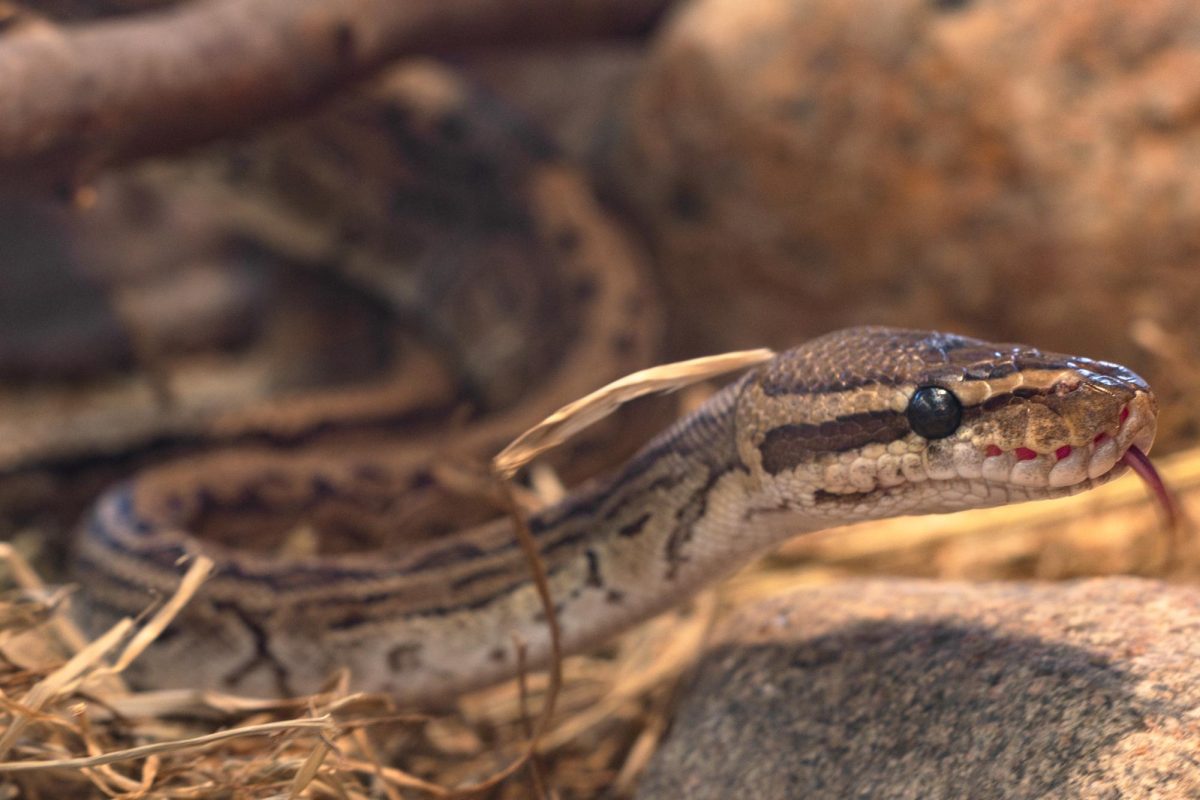
Many organisms — lush plants to ball pythons to cages of beetles — call C217 home. During U-High’s lunch and lab periods, it is common to see a student of any grade doing work with one hand while a snake wraps around the other.
Being hypoallergenic and easy to handle, there’s a lot to like about the snakes. Biology teacher Daniel Calleri, the primary caretaker of the snakes, appreciates that they don’t make a big mess.
“Snakes do not need to eat constantly, and so you only need to feed them once every couple months, and then cleaning them up is pretty easy,” Dr. Calleri said. “So from a classroom management perspective, they’re perfect.”
Dr. Calleri adds that there is a mental health benefit to having greenery and animals in a biology classroom.
“There is an entire body of literature around having animals and plants — living things in general — in classroom spaces in regards to their positive effects on student mental health,” Dr. Calleri said.
Snakes only need to be fed every few months so can be left at school over the summer. However, many students have taken them home over the long break, including sophomore Tal Neiman. Tal was overjoyed when she saw that her biology classroom had snakes in it and grew attached to one in particular who she later took home last summer.
“She was such a joy, I love her so much,” Tal said. “Snakes are awesome.”
Entomology Club’s salamanders
While most classroom pets are owned by the teachers, two blue-spotted salamanders have a different story. In C217, two blue-spotted salamanders are official members of the Entomology Club. As a way to branch out from merely studying and observing insects, the members of the club bought two blue-spotted salamanders last year to diversify the pets they already had.
The Entomology Club’s two stag beetles died earlier this year. The club’s leaders, juniors Caleb Richards and Aslan Doğan, are the salamanders’ primary caretakers.
Because salamanders have highly sensitive skin, they can’t be held like the pythons. However, they provide entertainment twice a week when they eat, Caleb said.
“They’re pretty explosive when they feed,” Caleb said. “They’ll jump out at your hands or pretty much anything that moves, so it’s pretty fun to watch that.”
Daniel Bobo-Jones’ snake:
U-High’s other snake lives just across the hallway from Dr. Calleri’s. Formally called Isis by a lower school classroom and now nameless, this scarlet kingsnake is taken care of by biology teacher Daniel Bobo-Jones, and her species is an example of Batesian mimicry of the venomous eastern coral snake.
“I like her because she’s a good example of a coloring pattern that often gets mistaken for an actual poisonous snake, so sometimes people think she actually is poisonous and she’s not,” Mr. Bobo-Jones said. “It’s the kind of thing where people are afraid of something for no reason.”
Mr. Bobo-Jones purchased her as a hatchling in 2010. In 2012, a lower school classroom borrowed her, but when that teacher left in 2018, the snake returned to Mr. Bobo-Jones’ classroom.
While her species is too quick to be held often, she still offers educational value on snake behavior and reptile biology.
“They’re good examples of lizard evolution,” Mr. Bobo-Jones said. “These guys come off of a branch of the lizards and are not true lizards but true snakes. There are actual lizards that don’t have legs.”
