







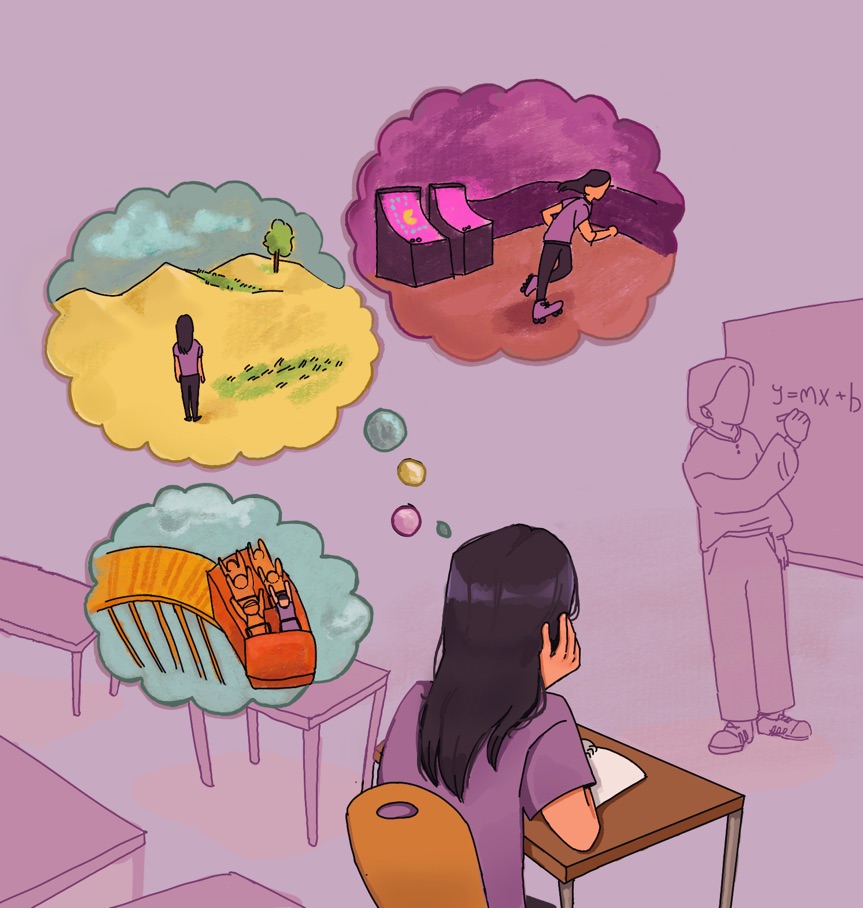










When February rolls around and students begin crafting their schedules for the following year, a familiar sentiment follows students into counselor meetings and across conversations: I have a class I want to take, but it doesn’t fit my academic path or doesn’t strengthen my transcript.
The classes most often sacrificed or treated like a burden are what makes U-High a unique academic environment. It’s courses like food chemistry, cosmology, journalism or digital music that are left out or looked down upon in favor of courses students feel can serve their academic future.
This attitude reveals a troubling definition of success at U-High: that exploring new interests and achieving traditional markers of success are mutually exclusive.
The pressure behind this thinking is understandable, and something many of us participate in. A rigorous course load and AT classes stacked in the “right” subject areas can create a college application that tells a cohesive story of a focused student to an admissions officer — or so we’re told. But this framing sets up a false choice: that exploring something new is wasting an opportunity rather than creating a new one.
Beyond the classroom, U-High offers so many opportunities for students to engage with new topics. Student-led workshops at Social Justice Week and ArtsFest are rarely framed as opportunities, instead considered by many to be lost time for homework or rest.
The guiding philosophy of the Laboratory Schools was never about funneling students into a single path to success. John Dewey, the founder of the Laboratory Schools and education reformer, argued that education should expand curiosity. In his view, the purpose of school is to foster an environment for growth. Pushing past the expectations others set for us is what Dewey envisioned.
This tension between specialization and exploration is not specific to U-High. Articles in the Brown Alumni Magazine, UW-Madison Daily Cardinal and Columbia Spectator discuss the debates within their institutions about the merits of an increasingly pre-professional college experience. For Brown University, a college with a uniquely open curriculum, this debate has been central since the 1970s. If the question of balancing a strictly preprofessional attitude toward education or one geared toward exploration is still a discussion in college, forcing an answer in high school only closes doors early.
Although U-High students can’t change the systems that look at transcripts or resumes, we can take the steps to reframe unique opportunities, not as distractions but as investments in a different kind of success.