


















Promotional content for “Wicked: For Good,” the recently-released “Wicked” sequel starring Cynthia Erivo and Ariana Grande, has been incessant. The “Wicked” team has made every dollar of their $150 million marketing budget count by releasing a deluge of social media content, hundreds of cast interviews, thousands of varying merchandise lines, and even lighting up Chicago’s famous Willis Tower in the iconic green-and-pink “Wicked” palette. But every time I’ve been greeted the last few months by a smizing Ms. Erivo in a green pleather ensemble or the wide doe-eyes of Ms. Grande in a pink gown, I’ve wondered to myself: Why is no one talking about how unhealthy these women look? And why, oh why, is this movie being marketed to tens of millions of impressionable young girls?
The answer, of course, is complicated.
Genuine concern for a woman’s health can so easily be conflated with criticism or “trolling,” especially within the echo chamber of a social media platform. One might gently suggest under a “Wicked” promo post that Ms. Erivo and Ms. Grande need help, and that person would swiftly be crushed by a mob of users telling them that these stars are beautiful just the way they are and that mentioning their bodies is inherently harmful.
The thing is: we need to talk about it, because “Wicked: For Good” is a movie with a nearly 70% female audience, many of whom are children. We can talk about the pressures placed on performers without degrading them. We can teach media literacy instead of tiptoeing around images that clearly deserve scrutiny. We can ask why the “Wicked” machine is comfortable commodifying a look that so many young viewers will chase to their own detriment.
The truth is that young girls are watching. They’re absorbing the corseted silhouettes and the jutting bones. They are being told — explicitly and relentlessly — that this is what beauty looks like. Not because Ms. Erivo or Ms. Grande set out to harm anyone, but because the system that employs them has realized that maintaining the illusion is more lucrative than acknowledging the cost of it.
With all due respect to director Jon Chu: to put a man at the helm of “Wicked” is to put a lot of feminist responsibility on his shoulders, and Mr. Chu has failed his vulnerable audience. He has done so by making an active choice to pretend like Ms. Grande and Ms. Erivo are healthy — and in fact, Ms. Grande’s protruding shoulders and clavicle are adorned with rhinestones in the movie, a creative choice that intentionally highlights her emaciated frame.
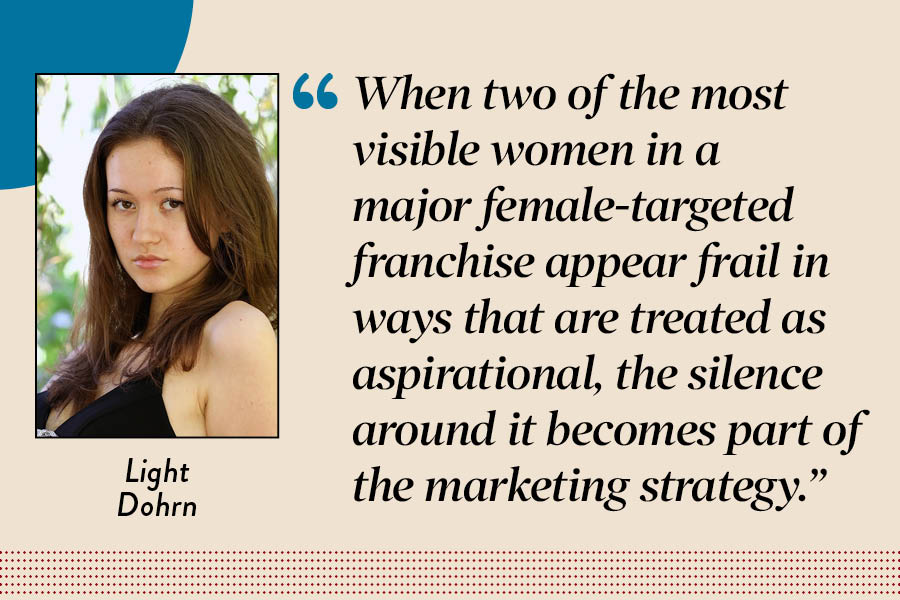
But the problem isn’t one director or even one marketing team — it’s an industry that continues to promote thinness as aesthetic excellence. When two of the most visible women in a major female-targeted franchise appear frail in ways that are treated as aspirational, the silence around it becomes part of the marketing strategy.
The irony is that “Wicked” — a story about seeing past appearances, about questioning who gets to be considered “good” and “beautiful” in the first place — should have been the perfect opportunity for a mainstream franchise to model something healthier. Instead, it has doubled down on an aesthetic that feels out of step with its own message.
When a studio spends $150 million on marketing, it shouldn’t pretend it has no responsibility for what those millions amplify. And if we’re told that raising concerns about the bodies presented to millions of girls is off-limits, then we’ve created a media landscape where the only acceptable response to harmful beauty standards is applause.


E • Dec 19, 2025 at 11:09 am
I respect your opinion. However, a couple things.
This is a topic that is being discussed constantly, and so “why is no one talking about” this isn’t a fair or accurate assessment. A short google search will bring up hundreds of results discussing exactly what you have talked about here.
People can be skinny for many reasons. Wicked does not talk about skinninesswhatsoever. Therefore, your entire argument is that skinny people being seen by young girls is inherently a bad thing. In other words, existing as a skinny person is harmful to those around you. Why is it ok to describe a skinny person in such detail (frail, unhealthy, emaciated, and with protruding shoulders) when if the situation were reversed, it is obviously not okay?
As for “The irony is that “Wicked” — a story about seeing past appearances, about questioning who gets to be considered “good” and “beautiful” in the first place — should have been the perfect opportunity for a mainstream franchise to model something healthier.” What does that mean? Ariana Grande and Cynthia Erivo are too skinny to be part of Wicked, and someone healthier should’ve gotten the role?
I get where you’re coming from, but I don’t believe we ever have a right to discuss other people’s bodies and health, in any circumstance.